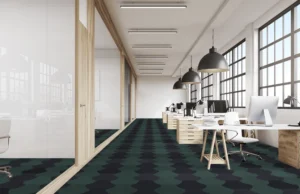
The use of raised access flooring is a common practice in managing and controlling airflow in data centers. Inefficiencies in this process can compromise operations due to inadequate temperature regulation, leading to higher maintenance costs and increased energy consumption.
For this reason, the integrity and proper installation of raised access flooring are essential to ensure the efficiency of a floor-integrated ventilation system. Next, we’ll explore how raised access flooring becomes an invisible ally in energy efficiency and in reducing air and energy waste.

Possible Causes of Air Leaks
Small details can have a big impact. The main factors that ensure the airtightness of the flooring—and should therefore be carefully considered—are:
- Installation and Maintenance: Proper installation is a prerequisite for flooring airtightness and should be carried out by professionals. During maintenance, care must be taken not to damage or displace the seals on stringers and pedestals; if they are damaged, they should be replaced.
- Dimensional Accuracy: It is important to ensure that the flooring system is Class 1, according to EN12825, which regulates the dimensional tolerances of the panels.
- Panel Edge Finishing: The panel should be equipped with protective edges, which are essential for sealing the joints between panels. The absence of this finishing can lead to significant air leaks.
- Seals: The columns and stringers that make up the panel support structure must be equipped with seals. The room perimeter is often one of the main areas of air pressure loss, so it is essential to ensure that the system includes adequate seals to maintain airtightness around the perimeters.
Performance of Raised Access Flooring
To quantify the level of air leakage in raised access flooring under ideal conditions, a laboratory test was conducted using a standard configuration of panels and their supporting substructure. A mockup consisting of four 600×600 mm panels with a height of 500 mm was placed in a sealed chamber and sealed along the entire perimeter. A fan was connected to the chamber via a duct to supply airflow under different pressures. The controller allowed the airflow to be varied and maintained constant long enough to obtain accurate readings of flow and pressure.

Four tests were conducted with different panel mounting configurations:
- Test with Zero Gap Between Panels: Aluminum adhesive was used to seal all joints.
- Test in Standard Installation Mode: The panels were positioned normally, as they would be on-site.
- Test with a 0.3 mm Gap
- Test with a 0.6 mm Gap
The purpose of the last two configurations was to simulate the natural use and wear of the raised access flooring over time. In each test, the air leakage rate was measured and calculated in liters per second per linear meter of joint, within a pressure range of 0 to 120 Pa (the device’s performance limit).
The test also included a preliminary smoke test to verify the proper installation of the flooring, both between panels and along the room perimeter. Pressurized smoke was introduced into the floor-integrated ventilation system to make any leaks caused by construction errors or incorrect connections visible.

The test confirms that a properly designed and installed raised access floor ensures optimal pressurization of the ventilation system, preventing leaks and resulting inefficiencies.
For reference, the pressure under the floor at which the panels would theoretically begin to lift is equal to the weight of the panel per unit area. For example, for the PG6ALV panel (calcium sulfate core, steel bottom layer, and vinyl finish), this pressure is approximately 500 Pa.
Cooling Systems in Data Centers
Data centers are currently in a rapidly growing sector, driven by the integration of artificial intelligence. They must provide ever-increasing computing, processing, and data storage capabilities while ensuring efficiency and sustainability.
Nesite raised access floors ensure optimal pressurization of your underfloor ventilation systems, which can be complemented with joint sealing solutions (Labfloor system). In addition, the company’s commitment to sustainability is confirmed by major international certifications such as FSC, EPD, CE Marking, and Cradle to Cradle.
If you are looking to integrate sustainable, high-performance raised access flooring systems into your projects, get in touch with Boleado.